

Real estate investment risk is not one single number or warning sign. It comes from a series of decisions about a property, its price, repairs, strategy, timeline, and your ability to carry out the plan. Beginners do not need every answer before exploring an opportunity, but they do need a clear way to ask better questions.
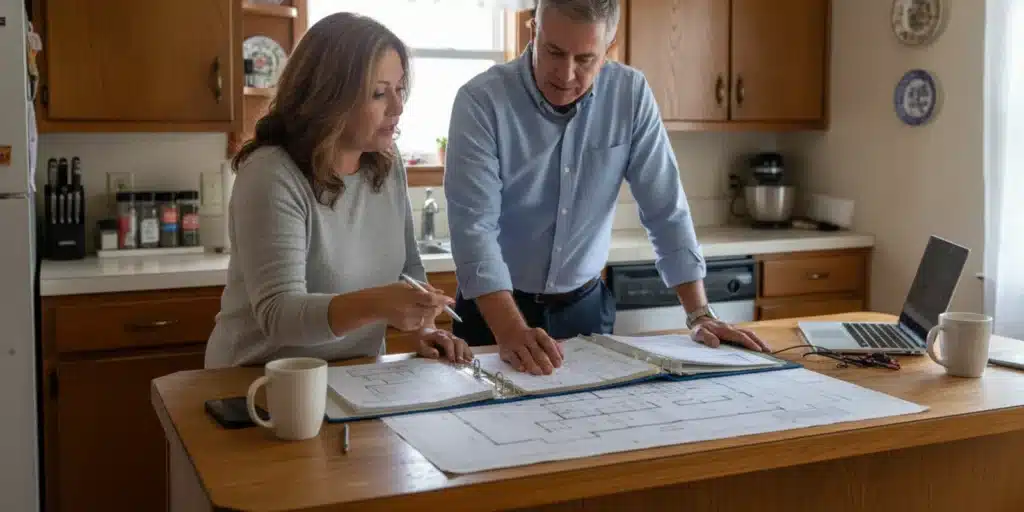
A careful review cannot guarantee a successful deal. It can help you see what is known, what still needs checking, and whether the opportunity fits the approach you are considering. This guide offers a practical framework for that review, whether you invest independently or consider working alongside an experienced partner. The aim is not to remove every uncertainty. It is to make the important assumptions visible before they become commitments.
What does real estate investment risk include?
Risk is the possibility that actual results differ from your plan. A property may need more work than expected. A sale may take longer. The market may shift, a buyer may not appear on schedule, or a contract detail may create a problem. Some issues can be reduced through research and careful execution; others remain outside an investor’s control.
It helps to separate risk into parts instead of treating it as a vague feeling. Write down the assumptions behind an opportunity, then identify how you would verify each one. This turns “Does this feel safe?” into more useful questions: “What evidence supports this repair estimate?” and “What happens if the project takes two months longer?” You can then decide which uncertainties are manageable, which need more information, and which are reasons to pause.
| Risk area | What to check | Question to ask |
|---|---|---|
| Property condition | Visible defects, inspections, repair scope, contractor input | What could be hidden, and who has verified the estimate? |
| Valuation | Current-condition value, comparable sales, resale assumptions | What evidence supports expected sale value? |
| Costs and margin | Purchase, repairs, closing, holding, marketing, sale costs | Does the margin hold if costs rise or price falls? |
| Strategy and timing | Likely buyer or tenant, project duration, fallback options | Does this plan fit the property and my capacity? |
| Execution | Roles, decisions, paperwork, vendors, communication | Who is responsible for each next step? |
These categories overlap. A repair surprise can increase costs and lengthen the schedule. A longer schedule can add carrying costs and expose the project to changing buyer demand. Consider the chain of effects, not just each risk in isolation. For a broader look at how local conditions enter an investment review, read this guide to reviewing real estate market trends.
How can you assess the property before making an offer?
Start with the property itself. Photos and a quick walkthrough can help identify questions, but they do not replace appropriate inspection and due diligence. Ask about the age and condition of major systems, signs of water intrusion, roof condition, electrical and plumbing concerns, permits, and any work that may require specialist review. The right professionals and records depend on the property and location.
Do not turn an early repair guess into a settled budget. List each known item, the source of the estimate, and what remains uncertain. If a wall is closed or a system has not been tested, record that uncertainty instead of assuming the most favorable answer. A contingency can help account for unknowns, but it is not a substitute for investigating what you can. In a first pass, distinguish “observed,” “reported,” and “verified.” A seller’s description may be useful context, for instance, but it is not the same as a specialist’s inspection.
Make a repeatable condition-review list
Walk through the property with a repeatable list rather than relying on memory. Record the roof, foundation, drainage, visible moisture, windows, doors, heating and cooling, electrical, plumbing, and signs of past repairs. Note whether each item was observed, tested, or merely reported by someone else. “Roof looks fine from the street” is not the same as an inspection of its condition.
Separate urgent safety or structural questions from finish choices. A dated kitchen may affect buyer appeal, but active water intrusion or an uncertain foundation can change both the scope and feasibility of the work. Ask qualified local professionals to inspect items outside your knowledge. Before committing, confirm what access, inspection periods, disclosures, and records are available under the proposed contract. If access is limited or a document is missing, include that limitation in the decision rather than quietly treating it as resolved.
Separate current value from possible value
As-Is Value means the property’s current value in its present condition. After Repair Value (ARV) is an estimate of what it may sell for after the planned work is complete. Look for comparable properties that are genuinely similar in location, size, condition, and buyer appeal. A headline sale price in the area is not enough to establish ARV. A renovated property with a different layout or a more desirable location may not be a useful comparison.
ARV should exceed the purchase price for a fix-and-flip to have room for the rest of its costs and intended margin. Paying more than As-Is Value can sometimes make sense if ARV and the full budget still leave adequate margin, but the reasoning needs evidence. A higher As-Is Value can lower risk because there may be more value already present; it does not remove repair, market, or timing risk.
Write down why each comparison belongs in your analysis. If a comp differs in size or condition, note how that difference affects your confidence. Consider a conservative range rather than treating one resale number as certain. If a small change to the assumed sale value changes your decision, the estimate deserves more scrutiny.
How do you test whether the numbers make sense?
Build the full deal picture rather than judging an opportunity by purchase price alone. Include acquisition costs, repair expenses, closing costs, taxes, insurance, utilities, financing or capital costs where applicable, marketing, transaction costs at sale, and the cost of time. The exact categories vary by strategy and agreement. Use documented estimates where possible, and mark assumptions clearly.
Then test less favorable scenarios. What if repairs cost more? What if the sale price is lower than expected? What if the property takes longer to complete or sell? A simple sensitivity check can show whether a small change erases the anticipated margin or whether the deal has room to absorb variation. Do not present a best-case projection as the expected outcome.
- Write expected purchase and sale assumptions separately from verified facts.
- Ask who provided each repair estimate and what it excludes.
- Include holding time and carrying costs, not just the visible renovation budget.
- Check whether the margin stays within an acceptable range for the specific strategy.
- Document unresolved questions and the person responsible for answering them.
There is no universal purchase-price ceiling or area that automatically makes a deal viable. The numbers and acceptable margins depend on strategy and opportunity. A modest price does not make a weak deal strong, and a higher price does not by itself rule out a sound opportunity. Evaluate the full facts and whether the margin fits the plan. For a practical discussion of inputs and local conditions, see how to review real estate market trends.
Run a downside scenario, not just a best case
Suppose your initial plan relies on a particular resale value, repair scope, and schedule. Create a second column with assumptions that are less favorable: a lower exit value, added repairs, or a longer holding period. These are not predictions. They are checks on how sensitive the plan is to change.
For a simple example, imagine the first budget includes a defined renovation scope and a planned listing date. Now ask what happens if an inspection uncovers another repair and the listing date moves out by several weeks. Recalculate the added work and carrying costs, then see how the expected margin changes. Avoid inventing a single “safe” contingency percentage that is supposed to fit every property; the uncertain items, project scope, and local costs differ. The point is to understand the consequences of a change before you are committed to the original assumptions.
If a modest repair overrun and a short delay together remove most of the expected margin, the opportunity may need a lower purchase price, more reliable estimates, a different scope, or a decision to walk away. If the margin remains within your acceptable range, that still does not guarantee a result; it simply suggests the plan has more room under those tested assumptions. Keep the calculation transparent so another reviewer can trace every input.
Also distinguish cash-flow timing from total projected costs. An expense paid early can create pressure even if a later sale is expected to cover the full project. List when deposits, materials, insurance, taxes, utilities, and closing costs may be due. The ability to meet obligations throughout the timeline matters as much as a final spreadsheet total. In any partnership, confirm in writing which party handles each cost and how the agreement treats proceeds and expenses.
Which strategy fits the property and your capacity?
Fix-and-flip, wholesale, short-term approaches, and buy-and-hold are not interchangeable. A flip depends on purchase, repair, resale, and project execution. Wholesaling has its own contract, buyer, and closing requirements. Buy-and-hold calls for different calculations, including rental income, ongoing expenses, financing, management, and a longer timeline. Choose a strategy only after understanding its tasks and assumptions. Partner Driven’s usual partnership focus is fix-and-flip, short-term, and wholesale opportunities; buy-and-hold is a distinct method with its own computations.
| Approach | Key risks to assess | Useful early checks |
|---|---|---|
| Fix-and-flip | Repair scope, holding time, resale value, carrying costs | Condition review, comparable sales, budget, project plan |
| Wholesale | Contract terms, assignment or closing structure, buyer demand | Local legal guidance, title review, verified buyer interest |
| Short-term project | Exit timing, operating requirements, demand uncertainty | Define intended exit and costs to reach it |
| Buy-and-hold | Vacancy, maintenance, management, financing, long-term cash needs | Rental assumptions, expense estimates, timeline, management plan |
Your personal capacity matters too. Consider how much time you can give to speaking with sellers, reviewing opportunities, coordinating people, and responding when a project needs attention. Real estate investing does not require you to become a full-time investor tomorrow, but it does require honest expectations about the work and your availability. A person with limited time may still explore a deal, but should identify who will handle time-sensitive questions and how responsibilities will be shared.
For flips, Partner Driven’s stated lens favors blue-collar, working-class areas and properties at or below a market’s median price, where accessibility, broad buyer demand, a manageable scope, speed, and efficiency matter. These characteristics are not a guarantee of a viable deal, nor does an area label determine the answer. Evaluate the actual property, local demand, repair plan, strategy, and margin. High-end projects can involve custom materials and longer carrying periods, so examine delay and holding-cost exposure rather than assuming a premium finish will produce a better result.
Match the exit plan to the actual asset
Do not choose an exit just because a strategy sounds familiar. A property with a complicated repair scope, uncertain resale appeal, or limited comparable sales may not fit a fast flip. A rental plan is not automatically a safe fallback: it requires its own rent assumptions, operating expenses, management approach, financing analysis, and tolerance for a longer hold. Treat a fallback as a separate plan with separate numbers, not as a promise that any property can be converted to another strategy.
For a wholesale approach, clarify how the contract permits the intended transaction and whether a likely end buyer understands the property’s condition and terms. Local rules and contract structures matter, so obtain appropriate professional guidance. A possible exit is only useful if the steps, costs, and legal obligations are understood.
Check your own capacity against that exit. If you cannot monitor contractors or respond to decisions during a renovation, determine who will handle those tasks and how decisions are approved. If the plan assumes a quick sale, ask what you would do if buyer interest is slower. Naming the fallback does not eliminate uncertainty, but it prevents an unexamined assumption from becoming the entire plan.
How can experience and a second review help?
Experience is valuable because it can help you ask sharper questions before a decision becomes expensive. It does not make an investment risk-free. A knowledgeable reviewer may notice an unsupported ARV, missing holding costs, or an unrealistic repair timeline. You still need to understand assumptions and decide whether you are comfortable proceeding. Good review is not simply agreement with your first impression; it is a chance to find gaps while there is still time to respond.
Independent investors can seek input from qualified inspectors, contractors, real estate professionals, attorneys, accountants, and other relevant specialists. Be clear about what each person is reviewing and what falls outside their role. Keep records of estimates, comparable sales, contract terms, and decisions so you can trace how the plan was formed. Explore the steps in a real estate deal review as you build your own questions.
A second review is especially useful when the person who found the opportunity is also excited about it. That is not a criticism; enthusiasm can make it easier to overlook inconvenient details. Ask a reviewer to challenge the assumptions: Which repair item is least certain? What evidence would disprove the ARV? Which costs are missing? What event would make the current strategy no longer fit? A specific challenge is more useful than a general request to “take a look.”
A hands-on partnership is another possible structure, not the only path. Partner Driven focuses on residential fix-and-flip, short-term, and wholesale opportunities. The partner finds opportunities, talks with sellers, takes action, and learns to evaluate deals. Partner Driven reviews opportunities; for approved deals, the team can bring capital, training, personal support, deal guidance, and back-office coordination with title companies, closing attorneys, and agents. The partner remains active and in the driver’s seat. The division of roles matters: Partner Driven does not find the partner’s opportunity or remove the partner’s responsibility to take action.
For deals completed together, the applicable written agreement defines responsibilities, costs, and any 50/50 net profit split. Funding is subject to review and approval, and no particular person or opportunity is promised a specific outcome. Ask questions about the agreement and make sure you understand it before deciding. Read more about how the Partner Driven program works.
Partner Driven reports more than 20 years of operating experience and 3,600+ completed deals across multiple U.S. markets. Those company facts provide context, but they do not predict the result of your deal. Partner Driven works nationwide; a partner may pursue an opportunity close to home or choose to work in another area. Consider the opportunity and work required, not geography alone. The approved role framing is: “You bring the opportunity. We bring the capital, systems, experience, and support,” subject to review and approval.
Research can also offer a broader lens without substituting for property-level due diligence. An academic paper on UK property portfolios identifies interest rates as a significant risk factor across the portfolio types it examined. Its findings concern portfolio-level analysis and should not be treated as a forecast for an individual residential transaction or a substitute for reviewing your own assumptions. Read the academic paper on risk factors in real estate portfolios.
What should you ask before choosing a partner?
Do not evaluate a partnership only by a headline about capital or support. Ask for a clear explanation of how opportunities are reviewed, what approval means, who makes which decisions, how costs and proceeds are handled, and what the written agreement says. Ask what work remains yours, how updates happen, and who you can contact when new information changes the plan.
- What information is needed to review an opportunity?
- What happens if the opportunity is not approved?
- Who verifies repairs, valuation, and the project timeline?
- How are costs, responsibilities, and net proceeds defined in writing?
- What happens if the project takes longer or the exit changes?
- What practical time and communication commitments should I expect?
Also ask how support works in practice. Who provides coaching and at what points? Who coordinates title, closing, and renovation details on an approved deal? How are scope changes documented? What are the partner’s responsibilities before a property reaches review? These questions clarify the working relationship without assuming one person can remove all uncertainty. Confirm whether a decision is yours, the partner’s, or shared, and how a disagreement or newly discovered problem is handled.
It is reasonable to compare partnership with investing independently. Independent work gives you direct control over each decision, but it also means organizing the review, funding, paperwork, vendors, and closing processes yourself or assembling help from others. With a hands-on partnership, responsibilities are divided under the agreement, and the partner still sources opportunities, speaks with sellers, and learns to evaluate them. Neither route removes market or execution risk. Compare the obligations, decision-making, costs, and support that actually apply to your situation. You can also read about common mistakes new investors can work to avoid.
How can you turn what you know into a next step?
You may already have watched videos, read articles, looked at properties, and thought about the numbers. The next useful move may not be to collect another general checklist. Choose one opportunity or investing question you have already considered, and apply your knowledge to it. Write down what you know, what you are assuming, and what evidence would help you decide. That exercise can show whether the next step is more research, a professional review, a conversation, or simply waiting.
- Summarize the opportunity. Record the location, property type, proposed strategy, and reason it interests you. If there is no specific property yet, describe the kind of opportunity you are trying to understand.
- Separate evidence from estimates. Label each number as verified, quoted, or still a guess. Include the source and date where relevant, so you can tell whether an assumption is current.
- Identify the three biggest unknowns. Condition, resale value, access, contract terms, or timeline may deserve further review. Rank them by how much they could change your decision.
- Set a decision point. Decide what information you need before proceeding, renegotiating, changing the strategy, or stepping away. A clear decision point can prevent an open-ended review.
- Ask for a second perspective. Share the assumptions with a qualified professional or potential partner and ask what you may have missed. Make clear what kind of feedback you need.
For example, suppose you have a property in mind but only a rough repair estimate and one comparable sale. Rather than deciding immediately, list the unverified repair items, find additional relevant sales, and ask which professional can inspect the unresolved condition concerns. Then revisit the full budget, including the cost of time. If the opportunity still fits after those checks, you have a clearer basis for a decision. If it does not, learning that before committing is useful too.
This process can also help if you do not yet have a property in hand. You can use the same questions to understand what kinds of opportunities you want to pursue, what work you can take on, and what support would be useful. You do not need a perfect plan, more experience, or every answer to have a grounded conversation. Real estate is a business that involves consistent effort and decisions; exploring a path does not require you to become a full-time investor tomorrow.
Partner Driven’s planner-or-doer discussion may help you think about moving from preparation toward a practical action. A call can also be a way to talk through what you are trying to accomplish, properties you have considered, and what is keeping you from deciding. There is no need to arrive with a perfect deal or a fully formed plan. Keep the conversation focused on understanding the roles, review process, and next decision that would make sense for you.
Real estate decisions deserve care, clear communication, and room for honest questions. Take the time to understand the property, the numbers, the work, and any written agreement before you choose how to move forward.